"Filtration" and "reverse osmosis" often get used interchangeably, but they're built to do different jobs. Many Central Florida homes end up using both together, rather than choosing one over the other.
Whole-home water filtration
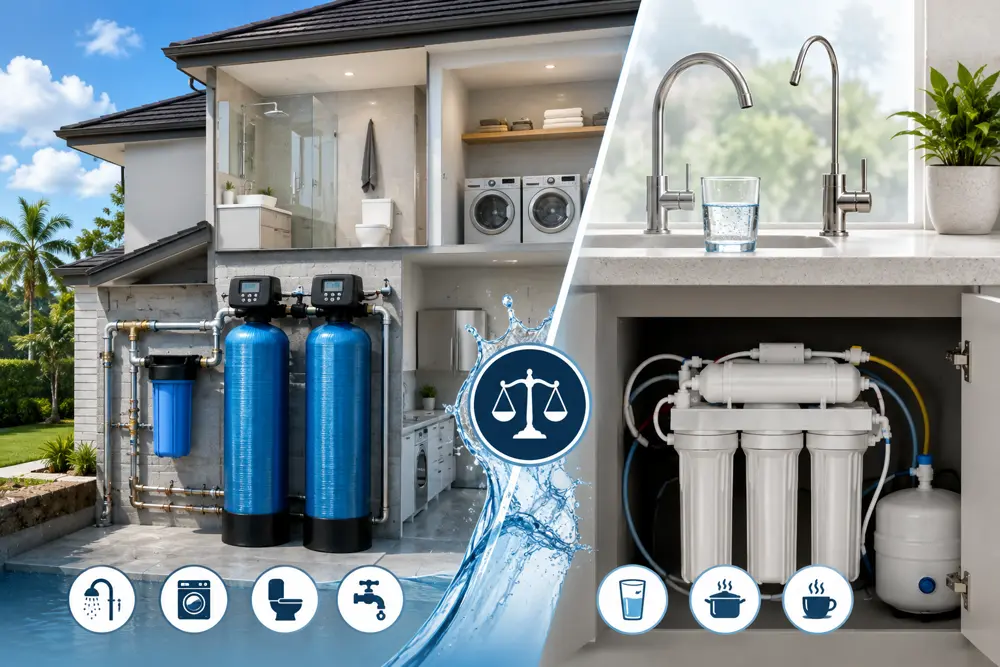
A whole-home filtration system is installed where water enters your house, treating every drop before it reaches a single tap. It's designed to address broader concerns across your entire water supply — things like chlorine taste and odor, sediment, and general water quality — so that showers, laundry, dishwashing and drinking water are all treated consistently.
Reverse osmosis (RO)
Reverse osmosis is a more targeted, high-precision process, typically installed under the kitchen sink to treat only your drinking and cooking water. It pushes water through a fine membrane that removes a wider range of dissolved particles, producing noticeably cleaner, better-tasting water right at the point you drink it.
So which one do you need?
In practice, it's rarely an either/or decision:
- Whole-home filtration protects your plumbing, fixtures and appliances, and improves water quality throughout the house
- Reverse osmosis focuses specifically on the water you drink and cook with, where taste and purity matter most
- Many homeowners choose both — whole-home filtration for the entire house, and RO for the kitchen tap
The right combination depends on what's actually in your water, which is why a water test is always the starting point rather than a generic package.